Your UX Isn’t Broken, But Your Service Design Might Be

User experience (UX) design is mostly associated with interfaces - interactions, and usability. However, modern digital products rarely exist in isolation and without context. A customer can encounter experiences with a range of services: customer support, onboarding, delivery systems, internal operations, communication channels, and even organisational policies. This perspective is where Service Design becomes essential.
Service Design within UX focuses on designing the entire service ecosystem, not just the screens customers interact with. It ensures that every touchpoint - digital or physical - works together cohesively to create meaningful and efficient experiences.
What exactly is Service Design?
Service Design is the practice of planning and organising people, processes, infrastructure, and technology to improve the quality of interactions between a business and its customers.
Traditional UX Design often centres on a single product or interface, whilst Service Design takes a holistic view. It examines how customers move through a complete journey and how systems and processes support or hinder that journey.
Service Design gone wrong
Picture this: You have a party to attend next week. You find “the” dress and the platform tells you that it’ll arrive 3 days before the event – perfect! You place the order. You get confirmation of the order and payment. You now sit back and relax. Then the delivery date arrives…but your order doesn’t. Your expected delivery date shifts to the week after the party. Now, you’re stuck – your expectation has been let down by the service.
Service Design is like cogs in a machine – if one fails, it can impact the whole process. In this example, the service could have been let down by:
- Payment systems
- Delivery logistics
- Stock control
- Warehouse management
- Notifications
- Customer support
- Refund handling, etc.
From the customer’s point of view, though, the whole experience becomes a disappointment - right from the initial excitement of the order. This could result in a loss for the business and its reputation for future purchases.
How can great Service Design improve my business operations?
Let’s go back to the example of the little black dress. How might your experience (as a customer) have differed if you had been notified earlier about any delays in shipment, giving you sufficient time to find an alternative? Or if the store made a conscious effort to contact you, apologising for the delay and potentially offering to support with a refund, or an alternative that would arrive in time?
Customers evaluate experiences as a whole, not as separate departments or interfaces. If your Service Design has a clear focus on customer needs, these processes can become more intuitive, accessible, and efficient for the customers and the business. Consistent and reliable experiences build trust, and when customers feel supported across all touchpoints, they are more likely to return.
As UX designers, we often focus on what users see and do on screen, but the overall experience extends far beyond the interface. This is where many teams fall short: they address individual touchpoints in isolation rather than considering the full end-to-end journey.
This becomes even more challenging in larger companies, which involve many stakeholders, systems, and dependencies that can complicate decision-making.
Unlike interface usability metrics, measuring the success of service outcomes can also become much more difficult to prove or provide metrics for - they may involve long-term indicators such as satisfaction, retention, or operational efficiency.
What’s the difference between UX Design and Service Design?
UX Design and Service Design are closely connected as they both focus on the user experience, but they operate at different levels.
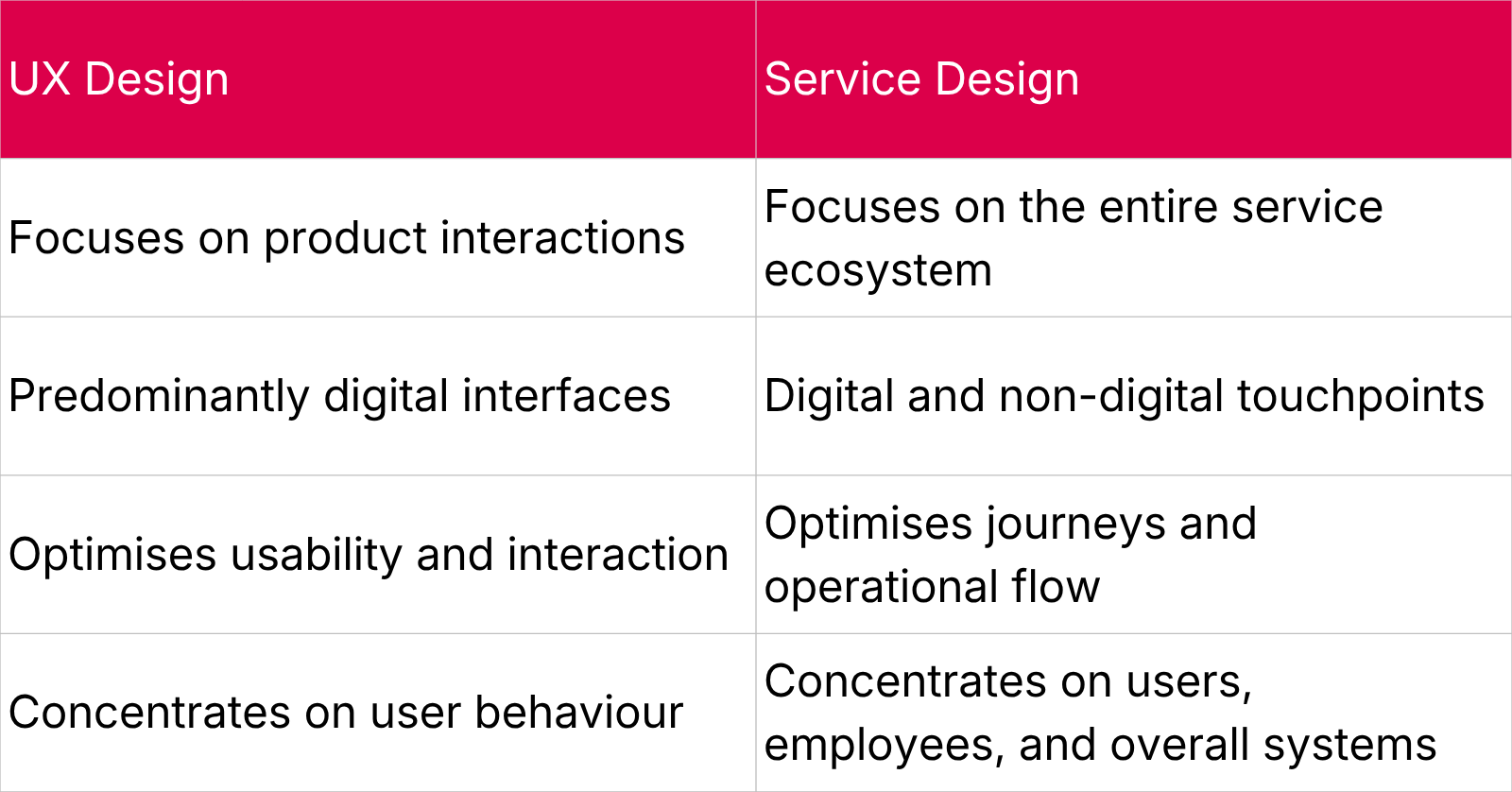
Service Design complements UX Design and vice versa. UX designers may improve the usability of a checkout page, while service designers investigate why delivery delays or support issues cause customer dissatisfaction after checkout. When both work hand-in-hand, the experience is seamlessly enjoyable.
How can we utilise UX Design to improve Service Design, and vice versa?
UX Design improves Service Design by providing data-backed insights into user needs, behaviours, and pain points through research and testing. This helps organisations design services that genuinely meet customer expectations. On the other hand, Service Design improves UX Design by providing a broader view of the entire customer journey. It helps UX designers understand how individual interactions fit into the wider service ecosystem. This prevents teams from optimising one touchpoint while overlooking problems elsewhere in the customer experience.
Ultimately, combining UX Design and Service Design enables organisations to create experiences that are user-centred, efficient, and consistent across every stage of the customer journey.
The future of Service Design
As products become more interconnected, Service Design is becoming increasingly important. Artificial intelligence, automation, omni channel systems, and remote services are expanding the complexity of customer experiences.
Organisations are recognising that successful experiences depend not only on attractive and practical user interfaces and the problem-solving, meaningful experiences facilitated by user experience design, but also on the well-designed systems behind them.
Future Service Design trends may include:
- AI-assisted customer journeys
- Hyper-personalised services
- Predictive support systems
- Sustainable and ethical service models
- Wider integration between physical and digital experiences
Conclusion
Service Design extends UX beyond screens and interfaces. It focuses on designing the complete journey customers experience across all touchpoints, systems, and interactions. By combining user-centred thinking with operational strategy, service design helps organisations create experiences that are not only usable but also seamless, efficient, and meaningful.
In today’s interconnected world, great UX increasingly depends on great Service Design. Organisations that understand this relationship are better positioned to deliver experiences that satisfy customers and sustain long-term business success.
Are you sure you are offering the best experience to your customers? Talk to our experts to explore improvement possibilities: hello@eclipsegroup.co.uk