Client-side vs. server-side: why the answer isn't straightforward

A question that sits at the foundation of many experimentation programmes: where should our experiment code live?
The answer shapes your team's testing velocity, your data quality, how credibly you can respond when stakeholders come to you with a deadline and your ability to react to commercial moments. Get it right and your programme scales cleanly. Get it wrong and you waste time managing workarounds.
I’d argue that the best way to answer isn't to pick one winner, it's to adjust your approach depending on the scenario. If your programme has the capability to operate both methods, server-side and client-side, that’s exactly what you should be doing. To illustrate this, here are some scenarios and the case for which method fits best in each.
Scenario: A quick concept that needs validating before it can justify a place on the roadmap
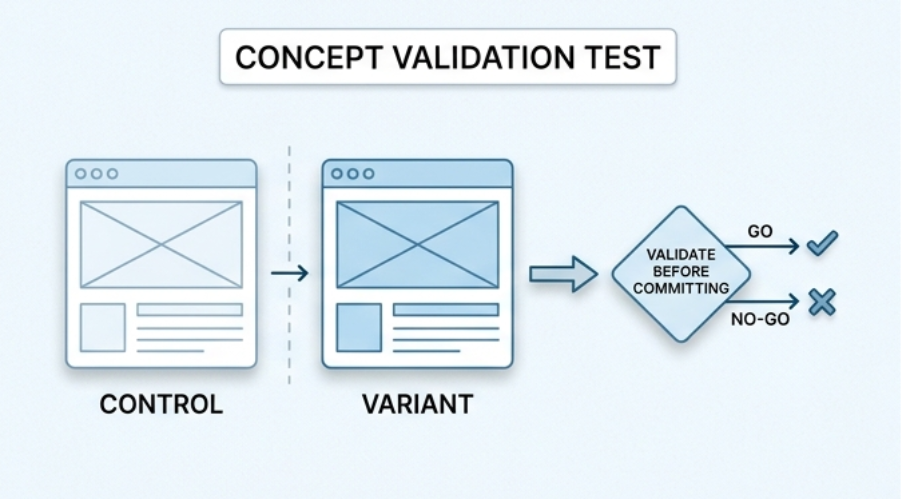
When a test needs to be informative rather than definitive, and the team isn't confident enough in a direction to commit engineering resource, client-side testing is often the right solution.
The nature of early-stage experimentation is exploratory. There are two or three possible directions and what's needed isn't necessarily a polished build, it's a quick answer.
Client-side testing makes that possible. Because experiment code lives outside the application codebase, the CRO team can build and deploy independently, getting a concept in front of real users much quicker. That's enough to take something back to the team and say what real users responded to, rather than making assumptions.
There's a codebase benefit too. If a hypothesis doesn't prove out, there's nothing to unpick - no dead code sitting inside the application that needs to be cleaned up. This makes client-side testing the natural home for early-stage concepts that still need to earn their place, rather than ideas that have already been validated.
It is worth noting that a client-side winner will still need to be rebuilt properly inside the main codebase before it can be rolled out as a permanent experience. Experimentation programmes that don't plan for that additional work tend to delay reaping the rewards of a winning test, which can ultimately mean losing out on the increased conversion or revenue that the test winner brought.
Scenario: The team wants to significantly change the journey in an upcoming test
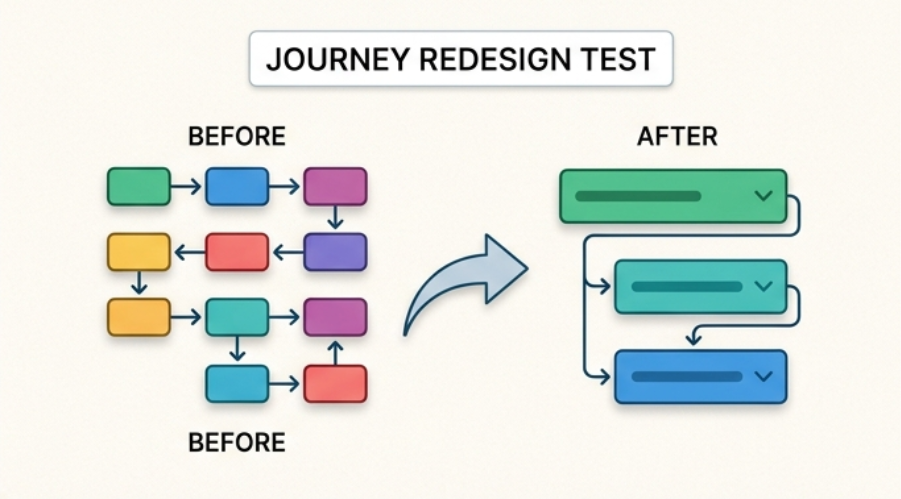
The team wants to restructure a multi-step flow which means reordering decisions, collapsing steps and surfacing different information at different points in the journey. It's the kind of test that could meaningfully move conversion and it's been on the roadmap long enough that there's genuine stakeholder appetite behind it.
For a test of this scope, client-side starts to look like the wrong solution. Client-side experiments are injected via JavaScript after the page has already loaded and with a significant journey restructure like this, there is a greater flicker risk. For instance, if a visitor lands on the original page before being redirected to an alternative route, even for a fraction of a second, the experience becomes jarring on pages where a smooth, trustworthy journey matters most.
Server-side is therefore the more appropriate method here. Experiment code is rendered as part of the page content, which means no DOM manipulation after page load and no visible flicker. The experience is clean in a way that client-side can't match for a change of this extent.
The trade-off is coordination. A test of this scope requires substantial engineering hours, which means sprint capacity needs to be accounted for well in advance. Otherwise, your most ambitious tests can too easily end up stuck in the backlog waiting for capacity to open up.
Scenario: There's been a last-minute suggestion to run a test during an upcoming promotion campaign and engineering's release cycle doesn't line up
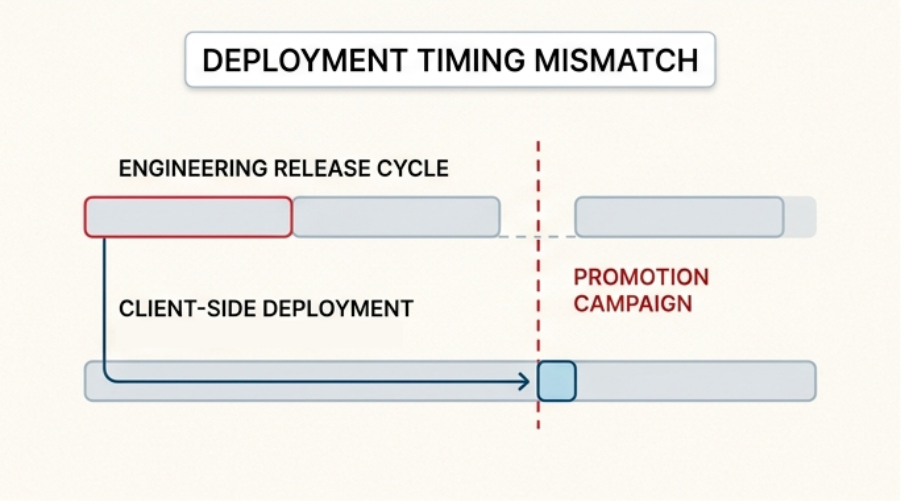
This situation is one of the main reasons why client-side testing can be a genuine organisational advantage.
Server-side experiments are subject to the same release process as any other code change: sprint planning, engineering capacity and a release window. When a stakeholder sets a deadline that doesn't align with that cycle, a server-side testing programme has limited options.
Client-side removes that dependency. Experiments are deployed independently of the application's release schedule, which means the CRO team can move on their own timeline without having to align with an engineering sprint. A two-week deadline that would be impossible under the server-side method becomes achievable.
This responsiveness has real commercial value. Programmes that can operate independently of engineering release schedules can react to moments, such as a campaign window, competitor move or seasonal opportunity, that a server-side-only programme would routinely miss.
That being said, the limitations of client-side testing don't disappear under deadline pressure and the proposed test still needs to be appropriate for the method. Being clear on what client-side can and can't deliver is what separates a team that manages expectations from one that overpromises.
Scenario: The team wants to run a test targeting a specific audience, but the segment can't be built from browser data alone
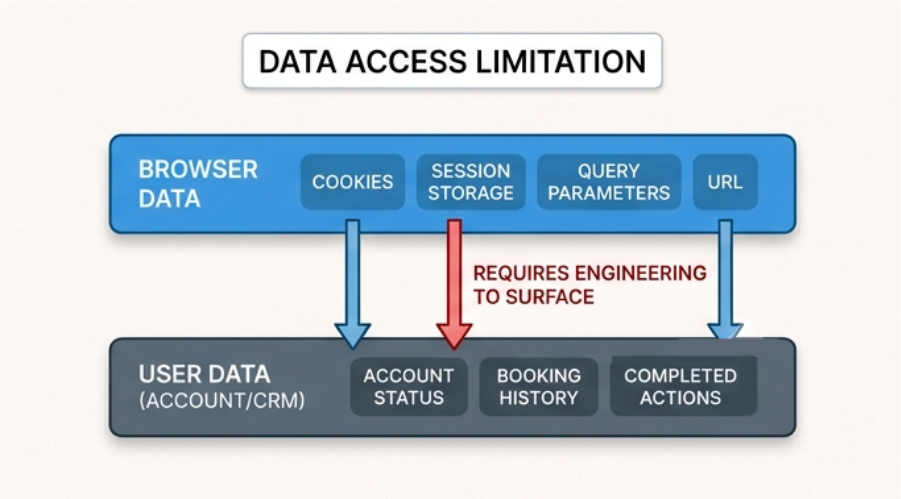
This may not be a limitation for every team but for those wanting to run experiments on specific user segments defined by backend data, it's a compelling reason to consider server-side testing.
The complexity here lies in the targeting. Client-side targeting is limited to what the browser exposes, such as session storage, local storage and URL query parameters. Information such as whether a user has completed a specific action or holds a particular account status often isn't available in the browser at page load, but at the point a server-side request is evaluated, it is.
If a relevant signal is already available client-side, such as a cookie set at a certain point in the user journey or a value written to session storage after a key action, client-side remains viable.
However, if that signal doesn't exist yet, surfacing it requires engineering involvement, which adds the complexity and overhead you were hoping to avoid. The cleanest version of this test is therefore server-side or hybrid, for example where the targeting logic is evaluated server-side where the data lives and the front-end change is delivered however is most practical given the team's resources.
Conclusion
A mature experimentation programme is one that realises the method should be chosen to match the test, and that being constrained to one method is likely leaving some experiments either unmade or made badly.
In fact, it is best to operate a hybrid: some experiment code lives inside the codebase and some lives outside it. The decision of where any given test lives should depend on the specific circumstances and conditions of the test.
We shouldn’t be asking: which method do we use? Instead, we should be asking: how deep does this change go? Is engineering available in the window we need? Where does the targeting data live? The answers to these questions determine the method.