Beyond the Handoff: Building a Collaborative Bridge Between Design and Development
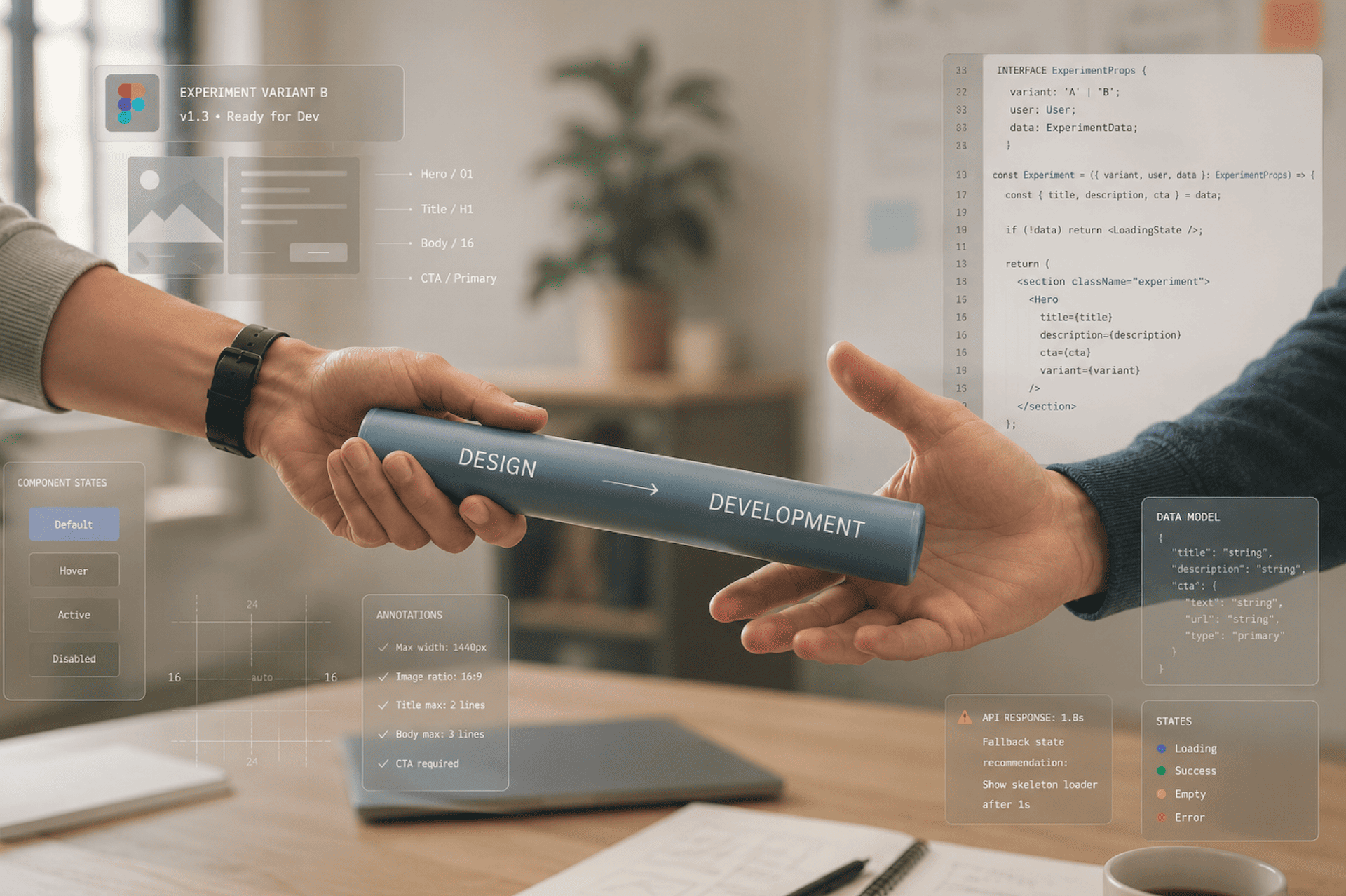
In the fast-moving world of A/B testing and experimentation, the transition from design to development is often treated like a relay race. The designer finishes their sprint, thrusts a Figma link into the developer’s hands, and considers their job done.
But if the developer hasn’t been running alongside the designer for the last few metres, they’re going to drop the baton.
Bridging the gap between the technical and the non-technical isn't about teaching designers to code or developers to draw, it’s about building a shared understanding of what each other needs to succeed. To move beyond the friction of the handoff, we need to stop viewing it as a single event and start viewing it as a continuous collaboration.
Stop Handing Over, Start Hanging Out
One of the most expensive mistakes a team can make is waiting for designs to reach the latter high-fidelity stage before involving development. Experimentation programmes often operate under unique constraints: a demand for high testing velocity, tight iteration cycles and limited windows to prove value. This means every delay compounds and a week of rework is a week of testing velocity lost.
The solution is simple: early involvement. When developers are part of the ideation phase, they act as a "feasibility compass". They can flag technical constraints and dependencies before a designer invests hours perfecting a solution that the architecture can't support or the timeline won't allow.
Without this, you get a familiar pattern: a designer spends three days working on a redesign, only to hear that "it requires a backend change that needs sign-off from XYZ”. The test gets delayed, the timeline slips, the team misses out on hitting their testing targets for the quarter.
With early involvement, you avoid this entirely and you shift the relationship. The developer stops being a recipient of designs and instead becomes a partner of design.
Documenting the ‘Invisible Logic’
A static mock-up is a snapshot of a perfect world. But in reality, dynamic data stored in APIs is rarely perfect and often stretches the limits of a clean layout. In experimentation, this becomes even more critical, as it can invalidate your results. If 10% of users qualifying for one variant hit a broken state, you're measuring two different experiences within the same variant.
To bridge the gap, designers must document the logic that isn’t visible on the surface. This ‘invisible logic’ is where most development time is spent:
- Worst-case scenarios: what happens when a product name is 50 characters long and breaks the layout? Or when the worst image in your image bank is displayed on a product card, does the card still look as intended?
- Data boundaries: What are the min/max values? Character limits? Input field constraints? Your API might allow 500 characters, but your design only fits 150, that needs to be explicit.
- Interactions and states: A button is never just a button. It requires a hover state, an active state, a focus state for accessibility, and a disabled state to avoid rage clicks on something that looks clickable but isn’t.
- State transitions: If the API takes five seconds to respond, what is the loading experience that the user should see in the meantime, rather than a blank page or component that could lead them to drop off?
When these are defined upfront, developers don’t have to make guesses during build and designers don’t have to scramble to add frames after the build has already begun. This eliminates the back and forth of Teams messages and prevents scope creep after estimates have been locked in.
Strategic Touchpoints
Real collaboration isn't a single meeting, it’s a series of intentional check-ins throughout the design lifecycle, each with a specific purpose:
- Early concept stage: The goal is high-level alignment, understanding whether the proposed solution is even possible given the tech stack and timeline. This might be a 20-minute conversation where the developer asks the necessary questions and that’s often all that’s needed to catch the major blockers.
- Mid-design stage: As the designer is building out component variations, the check-in serves as a “logic audit”. This is the time to take a deeper dive, uncover unanticipated scenarios, like how the layout reacts to dynamic content and where the design might break when it meets real data.
- Final hand-off: Before a single line of code is written, a final sync ensures all validation states, behaviours, transitions, constraints, etc are documented and understood. It’s the final alignment that ensures the developer has everything they need to write a comprehensive technical brief, allowing the build to start with total confidence rather than a list of questions.
It’s worth acknowledging that, even with the most rigorous preparation, software development is a process of discovery. During the actual build, it is likely that technical hurdles and logic gaps will come to the developer's attention. The goal isn't to reach 100% foresight, however the more we can avoid obvious logic gaps from creeping up mid-sprint by front-loading these conversations in refinement, the more headspace engineers have during development for solving technical challenges.
Summary
The goal of a great design-to-development process is to eliminate surprises. When we stop viewing the handoff as a single event and start viewing it as a continuous collaboration, we stop building in silos and start building with intent. We also stop seeing the developer as a bottleneck and understand why they require such thorough specification upfront - not to slow the designer down, but to accelerate the build.
In fast-moving CRO programmes where every testing cycle is precious, this collaborative approach is essential for faster builds, fewer surprises and tests that ship on schedule.